


Here's the math nobody talks about. An 11-foot hard paddle board takes up 11 feet of deck, garage wall, rack, or hatch real estate. On a 38-foot cruiser, 11 feet of any one thing is a luxury. On a 28-foot dayboat, it can be impossible. So most boat owners have spent the last decade doing one of three things: paddling something they hated because it fit, paying for separate rack space, or just not paddling at all.
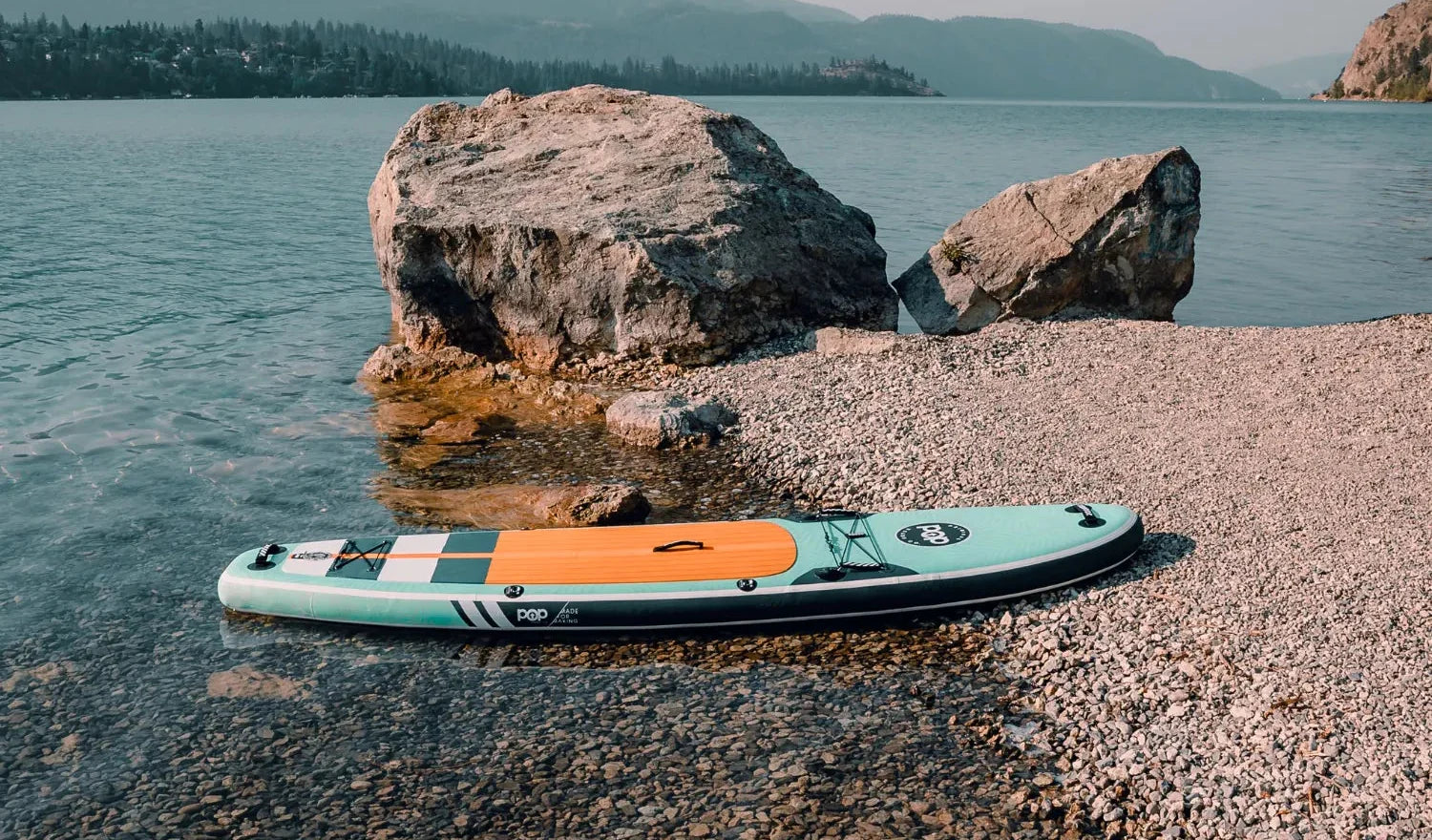
The 11'0" Yacht Hopper Inflatable Touring SUP in Mint/Teak/Blue was named for exactly this problem. Hop on the boat. Hop off the boat. Hop onto the SUP at anchor, paddle into a cove, hop back. We didn't pick the name to be cute. We picked it because that's how the board gets used.
Quick answer: The Yacht Hopper is a boat-owner-friendly inflatable paddle board because it gives you an 11'0" x 32" x 6" touring-friendly shape, front and rear cooler mounts, extra cargo D-rings, a complete kit, and an included wheel bag. A hard board still wins for permanent dock storage and pure race feel. The Yacht Hopper wins when storage, portability, boat launch reality, and actually using the thing matter more.
The Storage Problem: Solved
An 11-foot hard board is only convenient if you have 11 feet of clear storage and a way to move it without annoying every person on deck. That is the part hard-board people tend to skip. A hard paddle board is not just long. It is awkward around railings, grab handles, canvas, dinghy davits, dock lines, hatches, and every stainless fitting that seems personally committed to scratching it.
The 11'0" Yacht Hopper rolls down into its included wheel bag instead of claiming permanent deck space. I am not going to promise one universal packed measurement because boats are weird and lockers lie. Measure the storage space before you buy. Not the space you hope you have, the one you actually have. But the big point is simple: a rolled inflatable in a wheel bag can go places an 11-foot hard board cannot.
That single fact is why inflatable SUPs make so much sense for boat owners. We hear it from marina customers, boat-show conversations, and weekend paddlers all the time. The reaction to seeing an 11-foot board pack into a bag is usually half disbelief, half "why didn't I do this earlier?" Hard boards are not worse boards in absolute terms. They are worse boards for many boat owners because the storage cost is brutal.
Where It Actually Stows
Hatch lockers
On many 30-foot-plus boats, a packed Yacht Hopper can live near lines, fenders, hoses, or spare gear. Measure first, then claim the corner.
Under a settee or v-berth
Cruising sailboats and pocket cruisers often have awkward storage spaces that hate hard boards but tolerate soft, packed gear.
Lazarette or transom locker
A packed iSUP can sit with ropes, life jackets, dock lines, and a small cooler. A hard board cannot do that without taking over.
Cockpit floor while underway
In its wheel bag, the board behaves more like a large duffel than a roof-rack problem. Secure it properly before you move.
Try any of those with a hard board. You can't, at least not without straps, padding, arguments, and somebody eventually saying, "Maybe we just leave it at home."
The Inflation Problem: Also Solved
Here's the historical objection: "Inflatable boards take forever to pump up by hand and I'm not doing that at anchor." Fair. We agreed for a long time.
The SHARK 2S Rechargeable Electric SUP Pump changes the equation. It is a rechargeable electric SUP pump with dual-stage inflation, auto-shutoff, deflation mode, an 88.8Wh battery, and 12V DC plus USB-C charging options. The live product page describes full-size SUP inflation in about 8 to 10 minutes, with support up to 20 PSI. For the Yacht Hopper, set the target pressure to the board's recommended PSI from the valve or owner materials, not whatever number sounds toughest at the dock.
That is the breakthrough. A charged electric pump means you do not have to hunt for a 12V outlet, run an inverter, or turn the foredeck into a shoulder workout. Set the pressure, let the pump work, grab the paddle, check the leash, and get your day moving. Pre-electric pump, inflatables were a compromise. With a good pump, they become the obvious answer for a lot of boat owners.
The 11'0" Yacht Hopper: What Makes It Right for Boat Use
We've made other boards. The Yacht Hopper got named what it got named because of three specific design choices that matter to boat owners.

Front and Rear Cooler Mounts
You're not paddling a half-mile from your boat into a cove without bringing something. Sandwich. Towel. Drinks. Phone in a dry bag. Maybe a fishing rod if the anchorage looks too good to ignore. The Yacht Hopper gives you front and rear cooler mounts plus extra D-rings for cargo, which means you can secure a small soft cooler at one end and a dry bag at the other without buying a pile of aftermarket attachments.
Most boards force you to think like a backpacker. One bungee zone, one awkward stack of stuff, one bad wake away from chasing your lunch. The Yacht Hopper gives you a cleaner layout for the way boat people actually use a board: paddle out, bring the small stuff, come back dry enough to still enjoy the boat.
11 Feet Long, 32 Inches Wide, 6 Inches Thick
This is the useful middle. At 11'0" long, the Yacht Hopper tracks better than a short beginner board when you are paddling from an anchorage to a beach or around a marina. At 32" wide, it still gives you a stable deck without turning every paddle stroke into a reach. At 6" thick, the platform has the volume and rigidity you want when you are carrying gear, climbing on from a swim platform, or dealing with light boat wake.
Do not buy the biggest board because it looks stable. Buy the board that matches your body, gear, and water. For most boat-owner paddling, cove hops, marina loops, yacht-side cruising, calm lake mornings, and protected-bay exploring, the Yacht Hopper is in the sweet spot.
Designed in Santa Ana, CA
The Yacht Hopper was designed by a California board company that knows Newport Harbor, marina mornings, and the difference between pretty product copy and launch-day reality. Santa Ana is part of the brand's DNA. Newport-inspired boat use is part of this board's personality.
The colorways matter too. The Mint/Teak/Blue Yacht Hopper looks like it belongs next to a bright transom and a teak swim step. The Turq/Neon/Pink Yacht Hopper is the same board with more volume in the personality department. Born in Santa Ana, made for boat days that do not look boring.
The Anchorage Workflow: Start to Finish
Here's how this actually plays out on a typical Saturday.
9:14 a.m. You drop the hook in your favorite cove. Engine off. Coffee still warm.
9:15 a.m. Pull the rolled 11'0" Yacht Hopper Inflatable Touring SUP in Turq/Neon/Pink out of the hatch or locker.
9:17 a.m. Unroll it on the bow, cockpit floor, dock, or swim platform, wherever you have a clean, safe setup area without sharp hardware under the board. Connect the SHARK 2S pump, set the board's recommended PSI, and press start.
9:25 to 9:27 a.m. The pump finishes, depending on target PSI, board temperature, and starting pressure. Disconnect, close the valve, and install the fin before the board goes in the water.
9:28 a.m. Slide the board into the water from the swim platform or dock. Clip in the leash when you are clear of propellers, swim ladders, dock lines, and snag points.
9:29 a.m. You're paddling. The whole sequence is closer to making coffee than launching a second boat.
Try that with a hard board you did not bring because there was no room for it.
Saltwater Concerns, Briefly
Inflatable boards are saltwater-friendly with one caveat: rinse them. The Yacht Hopper uses premium PVC, woven drop-stitch construction, reinforced rails, and a yacht-deck-inspired EVA traction pad. That is real water gear, not a pool toy. But salt, sun, sand, and lazy storage still win if you give them enough time.
After your day at anchor, hose the board with fresh water before you roll it. Pay attention to the fin box, valve area, deck pad edges, leash plug, and anywhere sand likes to hide. Let the deck pad dry to the touch before bagging it. If you roll a salty, wet board and bury it in a hot locker for a week, do not act surprised when it smells like a marina towel.
Sun is a bigger long-term enemy than salt. If you can store the deflated board out of direct UV, in a hatch, under a cushion, under the v-berth, or inside the included wheel bag, it will have a much easier life than a board left inflated on an open deck all season.
Safety, Briefly, Because We're Honest
Even sheltered anchorages have boat traffic, current, wakes, wind, and swimmers. The U.S. Coast Guard SUP FAQ says a stand-up paddleboard used beyond the narrow limits of a swimming, surfing, or bathing area is considered a vessel, which means carriage requirements can apply. We recommend wearing a properly fitted, U.S. Coast Guard-approved PFD, not just stuffing one under a bungee where it helps nobody.
Leashes are not one-size-fits-all. The American Canoe Association SUP leash guide notes that coiled or hybrid leashes can make sense for flat lakes, tidal areas, and slow-moving rivers, while moving water and whitewater introduce snag risks that may require a quick-release waist system and training. Around a boat, keep the leash away from props, ladders, dock lines, and anchor lines. Clip out before climbing back aboard if it can snag.
Check wind before you paddle away from the boat. The National Weather Service marine warning guide explains small craft advisories and other marine warnings. A 10-knot offshore breeze that arrives after you launch is the kind of thing that turns a 20-minute paddle into a rescue story nobody wants.
Tell someone where you're paddling, especially if you are leaving the anchorage. For longer trips, use a float plan. Float Plan Central, from the U.S. Coast Guard Auxiliary, is built for exactly that kind of planning. Pretty gear still has to work. Safe gear comes first.
The Hard Board Counter-Argument, and Why It Usually Misses the Boat
You will hear hard-board folks say inflatables flex. Older inflatables did. Cheap inflatables still do. Modern woven drop-stitch boards inflated to the correct target PSI are rigid enough for the kind of boat-side paddling this article is about: cove hops, marina loops, lake cruising, casual touring, and paddling from the mothership to the beach. A hard board still wins for pure race feel, crisp rail response, and permanent dock storage. That is not the same as winning for boat ownership.
You will hear them say inflatables are slower. Marginally true on paper. In practice, on the kinds of distances you paddle from a boat, a few hundred yards to a mile, most people will never care. Wind, paddle technique, and route choice matter more than a tiny glide difference between a good inflatable and a hard board you left at home.
You will hear them say inflatables look cheap. Some do. The Yacht Hopper's Mint/Teak/Blue colorway looks like teak deck planking got invited to a lake party. POP was first to treat SUP boards like a canvas, and we've spent over a decade getting good at making water gear that looks like it was designed by people with a pulse. Look at the board. Make your own call.
When a Hard Board Still Makes Sense
Honest answer: if you have a private dock, a protected rack, zero storage pressure, and you paddle the same water every week, a hard board can be great. Hard boards are fast, clean, and simple when you have the space.
But boat owners rarely have unlimited space. You have fenders, lines, hoses, coolers, shore-power cables, life jackets, towels, tools, spares, kids' stuff, dog stuff, and one mystery bag nobody admits packing. The best board is not the one that wins a showroom argument. It is the one you actually bring, inflate, paddle, rinse, and store without turning the boat into a garage sale.
What to Bring With It
The Yacht Hopper package comes ready to paddle with the board, adjustable paddle, double-action pump, wheel bag, SUP fin, coil leash, and repair kit. That is the baseline. For boat-owner use, this is the practical upgrade list.
| Item | Why it matters from a boat | Pop Board Co option |
|---|---|---|
| Electric pump | Makes at-anchor setup realistic instead of turning inflation into a workout. | SHARK 2S Rechargeable Electric SUP Pump |
| Spare leash | Useful for flatwater and protected-water backup, but choose leash setup by conditions. | 10ft Coiled SUP Leash with Bungee Stretch |
| Wheel bag | Lets the board live like packed gear, not like a permanent deck fixture. | Included with the Yacht Hopper kit |
| Properly fitted PFD | The one piece of gear that matters most if wind, wake, or balance wins. | Source from a local paddle shop, marina, surf shop, outdoor retailer, or marine supplier |
That is not a 27-item influencer checklist. That is the stuff that changes the day.
Shop the Post
11'0" Yacht Hopper Inflatable Touring SUP, Mint/Teak/Blue
$799 sale price. Yacht-deck colorway. 11'0" x 32" x 6", about 27 lb board weight, T3 Woven PVC, complete kit, wheel bag, adjustable paddle, double-action pump, fin, coil leash, and repair kit.
11'0" Yacht Hopper Inflatable Touring SUP, Turq/Neon/Pink
$799 sale price. Same 11' x 32" touring-friendly board, brighter personality, front and rear cooler mounts, extra D-rings, and a colorway that refuses to blend into the marina.
SHARK 2S Rechargeable Electric SUP Pump
$149 sale price. Rechargeable electric pump with auto-shutoff, deflation mode, 88.8Wh battery, and support up to 20 PSI. The pump that finally makes inflatables practical at anchor.
10ft Coiled SUP Leash with Bungee Stretch
$29. A smart spare for flatwater and protected-water paddling where a coiled ankle leash is appropriate. Use leash judgment around boats, dock lines, current, and moving water.
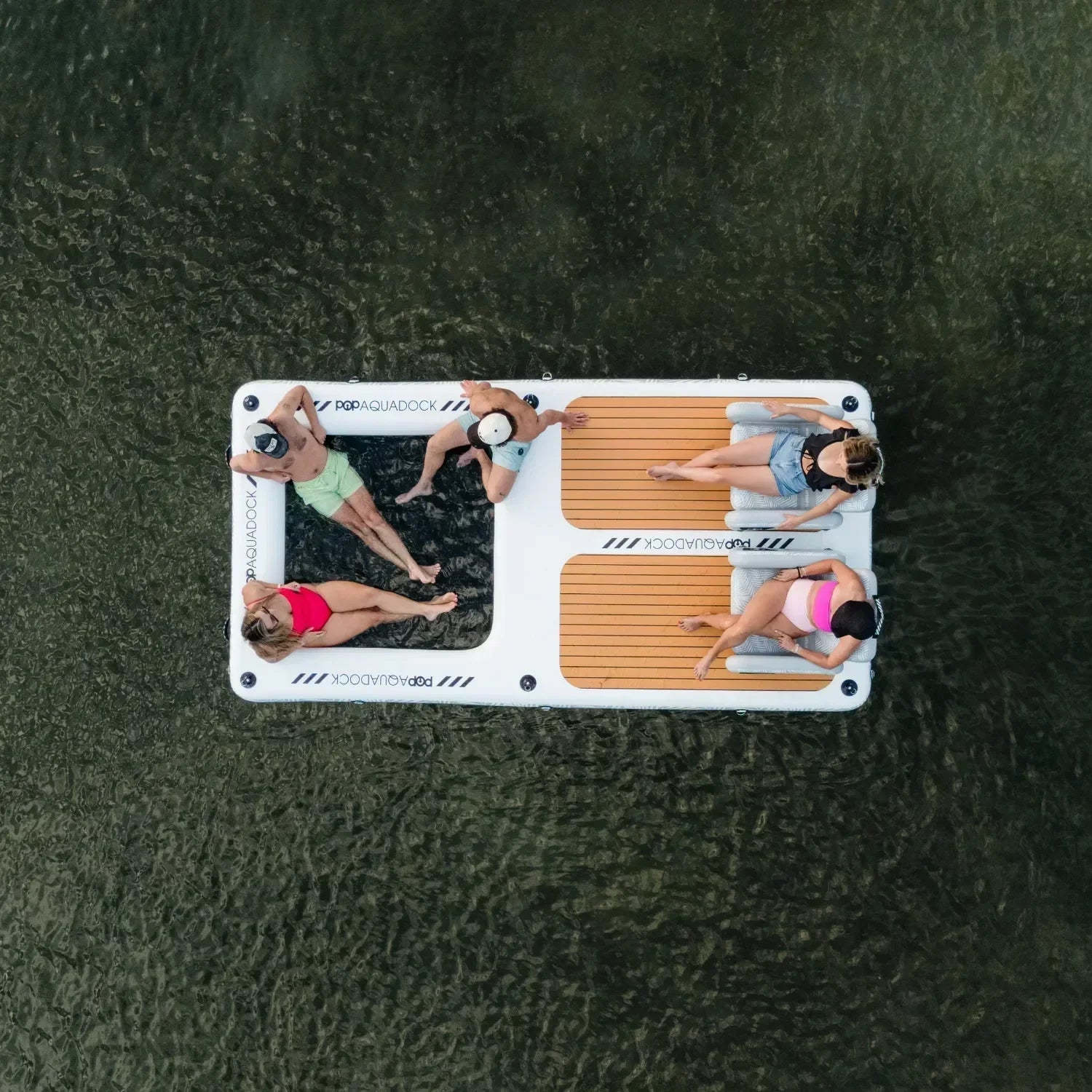
POPUP DOCK 8 X 7
$799 sale price. The Party Barge. An 8' x 7' inflatable platform with drop-stitch construction, 14 stainless steel D-rings, dual-action pump, carrying strap, handles, and 56 sq ft of boat-side space.
Need a floating platform to anchor next to your boat? Browse the full Pop Board Co inflatable docks collection. Building out your SUP kit? Check the Pop Board Co SUP accessories and gear collection.
FAQ
Can I store a paddle board on a yacht?
A hard board, almost never, unless you have dedicated rack space or a huge, protected deck area. An inflatable like the 11'0" Yacht Hopper rolls into its included wheel bag and can stow in many hatches, lockers, lazarettes, or under-settee spaces. Measure your actual storage area before buying because every boat is different. That is the entire point of the design: use an 11-foot board without permanently storing an 11-foot object.
How long does it take to inflate a SUP?
By hand pump, expect a real workout. With the SHARK 2S Rechargeable Electric SUP Pump, the live product page describes full-size SUP inflation in about 8 to 10 minutes, with auto-shutoff at your preset PSI and support up to 20 PSI. For the Yacht Hopper, set the pump to the board's recommended target pressure from the valve or owner materials. The electric pump is what makes inflatables practical for boat owners. Without it, inflation time is the friction point.
What's the best paddle board for a marina-stored boat?
An inflatable touring SUP, full stop. The 11'0" Yacht Hopper Inflatable Touring SUP is our pick because of the 11-foot tracking length, 32-inch width, front and rear cooler mounts, extra cargo D-rings, complete kit, and included wheel bag. It lets you paddle real distances from your slip or anchorage without fighting the board or renting separate marina rack space for a hard board.
Is an inflatable SUP durable enough for saltwater?
Yes, with normal care. The Yacht Hopper uses woven drop-stitch construction, premium PVC, reinforced rails, and an EVA traction pad, so saltwater use is part of the job. The maintenance step that matters is rinsing with fresh water after each saltwater session, clearing sand from the fin box and valve area, and letting the board dry before you roll it. Do not store it wet, salty, and hot unless you enjoy making gear sad.
Can I leave the Yacht Hopper inflated on the boat overnight?
Short term, yes, if it is secured, shaded when possible, and not baking at full pressure in direct sun. Overnight on a swim platform or cockpit can be fine when conditions are calm and the board is tied down properly. For multiple days, heat, UV, and pressure expansion become the issue. Easy rule: if you are not using it the next morning, drop the pressure or deflate it, rinse it if needed, let it dry, and bag it.
Made by US, Made for YOU.
The Yacht Hopper got its name because we wanted a board that worked from the boat as well as it worked from the dock. Boat owners get it the moment they unroll one. If you've been waiting for the inflatable that finally makes sense at anchor, this is the one. Born in Santa Ana, paddled from Newport to Nantucket.
Shop the 11'0" Yacht Hopper Inflatable Touring SUP
Browse the full Pop Board Co inflatable paddle boards collection

Leave a comment
All comments are moderated before being published.
This site is protected by hCaptcha and the hCaptcha Privacy Policy and Terms of Service apply.