


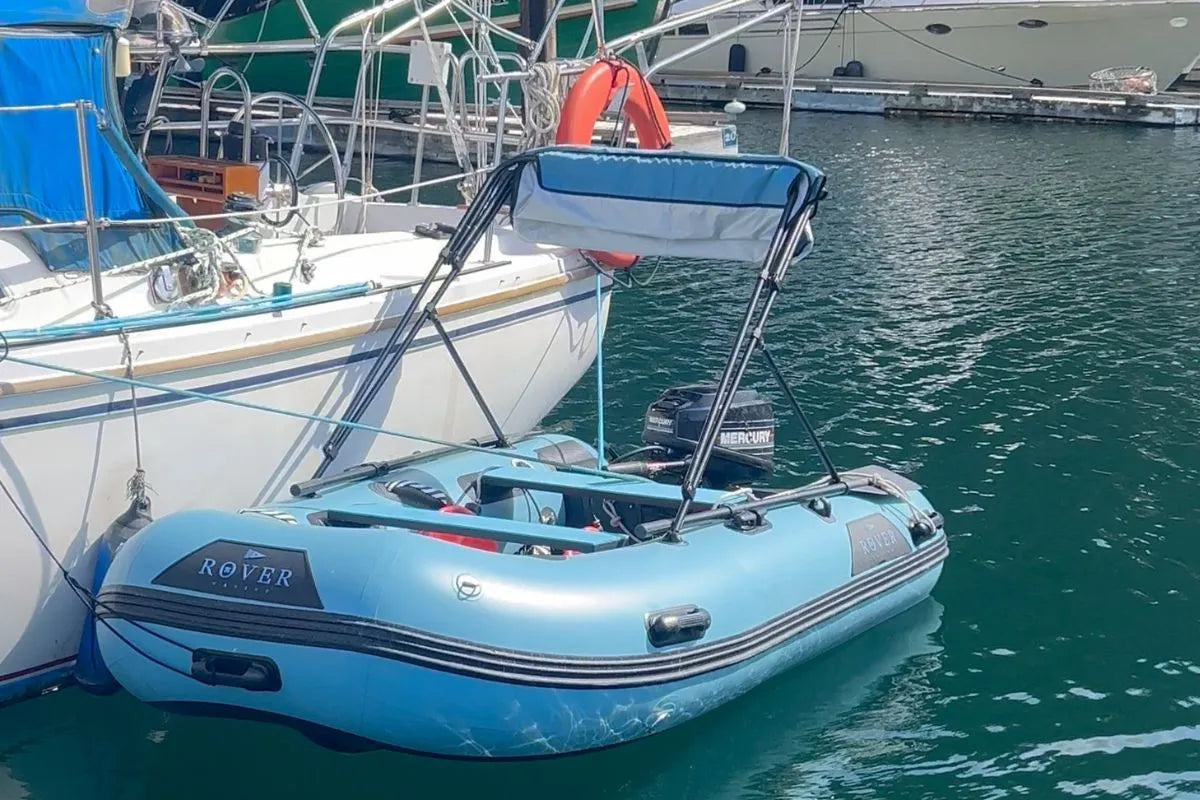
You've narrowed it down to Rover Marine on Pop Board Co. Smart. Now you have to answer the question that trips up every buyer at the $2,249 tier: do you want the catamaran or the single-hull inflatable boat?
Both boats wear the same attitude: Military-Grade Tech. Radical Aesthetic. Born in Santa Ana, CA. Both are built with T3 Woven PVC language on the live pages. Both use V-TEAK flooring. Both 10-foot models are rated for up to a 10HP outboard, list four-passenger capacity, and list a 1,000 lb load rating. The difference is the hull underneath the deck, and that hull decides how the boat feels in chop, how it reacts when passengers shift, how it tracks with gear on board, and how confidently a new operator can run it.
This is the spec-honest breakdown. No fluff. Two boats, four real questions, and a decision tree that ends with you knowing which one belongs in your cart.
Quick answer: Choose the 10' Rover Marine Battle Cat if you want the wider-feeling, more stable twin-hull setup for families, fishing, diving, swimming, and mixed-experience passengers. Choose the 10' Rover Marine Battle Boat if you want the more traditional single-hull feel, crisper handling, and a tender layout that feels familiar to experienced boaters. Both live product pages currently show a $2,249 sale price and product-description preorder notes for August 2026 delivery, so check the live page and cart before building a dated trip plan around either one.
The Two Boats, Side by Side
Here is what you are actually comparing. Both are 10 feet long. Both are currently listed at $2,249, down from $2,550, on the live Pop Board Co site. Both are part of the Rover Marine inflatable boats and catamarans collection we built for boaters who want something stronger, sharper, and more interesting than another plain grey dinghy.
The 10' Rover Marine Battle Cat is the twin-hull catamaran. Two parallel inflatable pontoons. Reinforced high-pressure floor. Five-foot beam. Four-passenger capacity. 1,000 lb load rating. V-TEAK flooring. T3 Woven PVC with Thermal Welding Technology language on the live page. 4+1 air chambers. Tube pressure listed at 3.5 PSI and floor pressure listed at 10 PSI. It is designed for stability, dry rides when properly loaded, easy open-bow water access, and carrying people plus gear without the nervous lean of a narrower hull.
The 10' Rover Marine Battle Boat is the single-hull sibling. Same 10-foot length. Same five-foot beam on the live spec panel. Same 10HP ceiling. Same 1,000 lb published load rating. Same four-person capacity. Same 4+1 air chamber listing. Same V-TEAK deck idea. But the underbody is a traditional single-hull inflatable layout instead of the Battle Cat's twin-pontoon catamaran architecture. It feels more familiar if your reference point is a classic yacht tender, sport dinghy, or small runabout.
Same DNA. Different geometry. Different boat.
| Spec | 10' Rover Marine Battle Cat | 10' Rover Marine Battle Boat |
|---|---|---|
| Hull style | Twin-hull inflatable catamaran | Traditional single-hull inflatable tender |
| Current verified price | $2,249 sale price, product-description preorder note for August 2026 delivery | $2,249 sale price, product-description preorder note for August 2026 delivery |
| Size | 10' x 5' | 10' x 5' |
| Boat weight | 98 lb in the spec panel, 100 lb in another live-page section | 100 lb |
| Whole kit weight note | Live page says whole kit is 120 lb with pump and bag | Live page says whole kit is 130 lb with pump and bag |
| Capacity | 4 people, 1,000 lb | 4 people, 1,000 lb |
| Motor rating | Up to 10HP | Up to 10HP |
| Air chambers | 4+1 | 4+1 |
| Package contents listed | Boat, two rowing paddles, two reinforced EVA-padded bench seats, high-capacity inflator, repair kit | Boat, two rowing paddles, two reinforced EVA-padded bench seats, high-capacity inflator, repair kit, carrying bag listed as "caring bag" on page |

Stability: The Catamaran Wins, and It Is Not Close
If you have ever stood up in a small single-hull dinghy and felt the world tip because somebody on the bench leaned over to grab a drink, you already understand the catamaran advantage.
Two pontoons, separated by a five-foot beam, give the 10' Rover Marine Battle Cat a more planted feel than a traditional single-hull inflatable of the same length. When a kid stands up to cast a fishing rod, the boat reacts with less drama. When two adults shift to the same side to land a fish or pull aboard a swimmer, the boat has more hull spread working against roll. The center of buoyancy is split between the pontoons, which is the whole point of a catamaran layout.
Real-world consequence: the Battle Cat is the right choice if you are loading the boat with kids, fishing gear, snorkel gear, dive bags, a dog, or any combination of people who were not born on the water. The open bow also makes entry and exit cleaner for swimming, snorkeling, diving, and beach landings. The live page describes the Battle Cat as a twin-hull design built to stay balanced and provide a rock-solid platform for fishing, exploring, or cruising. That is exactly the lane.
The 10' Rover Marine Battle Boat is stable too. It is a 10-foot inflatable tender with multiple chambers, a high-pressure floor, and a five-foot beam. It is not a kayak. But it behaves like a single-hull boat. It will lean more when weight shifts. It will feel more active in beam-on chop. For experienced operators, that is not a problem. For a first-time owner carrying passengers, kids, and coolers, it is a learning curve.
When the Single-Hull Wins on Handling
Stability cuts both ways. A wider-feeling, flatter catamaran platform tends to prioritize level behavior and load confidence. A single-hull tender tends to feel more familiar at the tiller.
The 10' Rover Marine Battle Boat is the more traditional drive. The live page describes it as a single-hull design optimized for speed and maneuverability. That matters if you are an experienced operator who wants sharper response, tighter maneuvering, and a familiar tender feel when running between a dock, mooring, beach, and boat.
Solo operators often prefer that kind of feel. There is less catamaran platform to manage, the boat behaves more like a classic inflatable tender, and small steering inputs feel direct. If your crew is usually one or two capable adults, the Battle Boat may be the cleaner everyday tool.
Pretty simple rule: the catamaran is calmer when people move around. The single hull feels crisper when the driver is the priority.
Load and Passenger Count: Same Published Load, Different Behavior
The 10' Battle Cat and 10' Battle Boat both list four-passenger capacity and 1,000 lb load capacity on the live Pop Board Co pages. So this is not a simple "cat carries more weight" decision. On paper, the published load number is the same.
The difference is how that load feels.
Four adults at average U.S. weight can put you around 720 lb before gear. Add a cooler full of ice, a small anchor and rode, tackle, dry bags, sandals, towels, and the mysterious extra bag nobody admits packing, and you are pushing real weight. Both boats list the capacity for that kind of day. The Battle Cat's advantage is that its twin pontoons distribute the load across two hulls and create a more settled stance when people move around. The Battle Boat can carry the load, but as a single-hull layout, you will feel fore-aft and side-to-side weight shifts more clearly.
For two-up cruising, ship-to-shore runs, or an experienced operator moving light gear between a mothership and beach, the Battle Boat is the right amount of boat. For loading up the whole family, the dog, a cooler, and fishing gear, the catamaran is the calmer bet.
The V-TEAK Floor, T3 Woven PVC, and 4+1 Chambers: What the Specs Actually Mean
Both boats share the same construction story, but a few live-page terms are worth translating without over-inventing specs.
T3 Woven PVC and Thermal Welding Technology
The live pages describe the boats as made with military T3 Woven PVC using Thermal Welding Technology on tube seams. That tells you the target use case: portable inflatable boats built for real tender work, beach landings, marina handling, fishing, swimming, and saltwater spray. We are not going to write a chemistry essay that the product pages do not verify. What matters is simpler: this is not a bargain-bin pool toy. It is a serious inflatable boat platform with reinforced construction language, high-pressure flooring, and a design brief aimed at yacht tenders and adventure craft.
V-TEAK Flooring
Both 10-footers use Rover Marine's V-TEAK flooring language. The live pages describe it as a non-slip PVC deck with a hyper-grip texture that improves fit, finish, and footing during boarding and offboarding. In plain English: it is the part your feet notice first. Wet feet need grip. Dogs need grip. Kids climbing in from the water need grip. A deck that looks good but turns slick is a bad day with better photography.
4+1 Air Chambers
Both 10-foot boats list 4+1 air chambers on the live Pop Board Co pages. That chamber redundancy matters because separate air chambers give the boat more margin than a single big bladder. If one chamber loses pressure, the rest of the system is still there to help you manage the situation and get back under control. That is not permission to ignore inspection, pressure checks, or repair gear. It is the reason serious inflatable boats use multiple chambers in the first place.
Safety Baseline Before You Add the Motor
A 10-foot inflatable with a motor is still a boat. It needs the same respect as any other powered craft: properly fitted, U.S. Coast Guard-approved wearable life jackets for every person onboard, state-required registration or numbering where applicable, a sound signal, required lights if operating near low light or after dark, and any other equipment your state or waterway requires.
The National Safe Boating Council FAQ says federal law requires a U.S. Coast Guard-approved wearable life jacket in good and serviceable condition and appropriate size for each person onboard, and children under 13 must wear an appropriate life jacket while a vessel is underway unless below deck or in an enclosed cabin, subject to state rules.
Check marine weather before coastal, harbor, or big-lake runs. The National Weather Service Marine Weather Services Program provides marine forecasts and warnings, and NOAA's marine weather warnings guide explains small craft advisories and wind thresholds. Wind matters more than vibes, especially in a 10-foot boat.
If you are anchoring, towing, or staging from a mothership, read the BoatUS anchoring and mooring primer. The right anchor, rode, bottom type, scope, and release plan matter. Pretty gear still has to work.
Lake vs Coastal: Where Each Boat Lives
If you are running a high-elevation lake such as Tahoe, Arrowhead, Big Bear, or a mountain reservoir, both boats can make sense when conditions are calm and legal access is handled. Pick by passenger count, load, and operator comfort. Catamaran for family days, fishing, and gear. Single hull for solo or two-up runs where handling feel matters more than everyone standing up to swap seats.
If you are running coastal protected water, Newport Harbor, Mission Bay, a marina fairway, a lee-side island anchorage, or a wake-heavy harbor, the 10' Rover Marine Battle Cat is usually the drier, calmer bet. The twin-hull geometry gives you more platform stability when wakes roll under the boat and passengers are not perfectly balanced. The open-bow layout also makes swimming, snorkeling, and getting in and out of the water easier.
If you are running it as a sailboat tender or power-cruiser tender, both work. The Battle Cat gives you passenger margin and boarding confidence. The Battle Boat gives you traditional tender feel and sharper handling. Do not buy the boat you wish your crew could handle. Buy the boat your crew will actually use well.

Sizing Up or Down: 8' and 12' as Alternatives
The 10-foot decision is not the only one on the table. Rover Marine builds the same general catamaran-versus-single-hull decision across 8-foot and 12-foot models on Pop Board Co.
Going Smaller: 8' Models
The 8' Rover Marine Battle Cat and 8' Rover Marine Battle Boat are currently listed at $1,999 each. They are the right move if you are stowing on a sailboat with limited deck space, parking in a smaller garage, or running a tender that normally carries one or two adults. The live pages list 6HP max power and two-person capacity for the 8-footers.
Same decision, smaller footprint: choose the 8' Battle Cat for stability and water access, or the 8' Battle Boat for traditional handling and simpler solo use.
Going Bigger: 12' Models
The 12' Rover Marine Battle Cat and 12' Rover Marine Battle Boat are currently listed at $2,599 each. The live 12-foot pages list 20HP max power, four-passenger capacity, 1,200 lb load capacity, and 12' x 5.5' sizing. The 12' Battle Cat page currently includes an August 2026 preorder note, so check timing before planning around it.
Pick the 12-footers if you have already outgrown a 10-foot dinghy and want the headroom to stop wondering if you should have gone bigger. Bigger boat, bigger storage, bigger setup footprint. Measure the storage space before you buy. Not the space you hope you have, the one you actually have.

The Decision Tree
Three questions, in order. Answer them honestly.
1. Who is on the boat most days?
Family with kids, mixed-experience passengers, dog on board, fishing gear, dive bags: choose the 10' Rover Marine Battle Cat.
Two adults max, both comfortable on the water: the 10' Rover Marine Battle Boat is a clean fit.
2. Where are you running it?
Harbors with wake traffic, protected coastal water, boat-side swimming, choppy lake afternoons: Battle Cat.
Flat lakes, sheltered coves, calm marina runs, experienced operator days: either works. Pick on stability versus handling feel.
3. What is the heaviest day?
Four adults plus gear: both list 1,000 lb capacity, but the Battle Cat distributes that day across twin pontoons and feels calmer when people move.
Two adults plus light gear: the Battle Boat handles it and gives you the crisper single-hull feel.
Most California buyers we talk to land on the catamaran for the same reason many cruisers land on the catamaran: more margin, drier-feeling passenger days, and fewer surprises with people who are not lifelong boaters. Experienced two-up tender operators often understand the Battle Boat immediately. That is why both exist.
Shop the Post
The Rover Marine collection on Pop Board Co currently includes three sizes and two hull types, six total SKUs.
10' Rover Marine Battle Cat
$2,249 sale price. Twin-hull inflatable catamaran. 10' x 5', 4 people, 1,000 lb capacity, up to 10HP, V-TEAK flooring, T3 Woven PVC with Thermal Welding Technology language, 4+1 air chambers, two bench seats, rowing paddles, high-capacity inflator, and repair kit.
Timing note: live product description currently says August 2026 preorder delivery.
10' Rover Marine Battle Boat
$2,249 sale price. Single-hull inflatable tender. 10' x 5', 4 people, 1,000 lb capacity, up to 10HP, V-TEAK flooring, T3 Woven PVC with Thermal Welding Technology language, 4+1 air chambers, two bench seats, rowing paddles, high-capacity inflator, repair kit, and carrying bag listed on the page.
Timing note: live product description currently says August 2026 preorder delivery.
12' Rover Marine Battle Cat
$2,599 sale price. Step up if you want the bigger catamaran platform, 12' x 5.5' sizing, 20HP max power, 1,200 lb listed capacity, and more room for family-day-boat use.
Timing note: live product description currently says August 2026 preorder delivery.
12' Rover Marine Battle Boat
$2,599 sale price. Bigger single-hull inflatable tender with 12' x 5.5' sizing, 20HP max power, 1,200 lb listed capacity, V-TEAK flooring, T3 Woven PVC language, two bench seats, rowing paddles, high-capacity inflator, repair kit, and carrying bag listed on the page.
Both 10-footers ship with the construction credentials that put Rover Marine in the conversation with serious tender brands, and both are built for the Pop Board Co customer who wants water gear with attitude instead of another forgettable white dinghy. We have always been seen as the taste-makers in our industry, from digitally printed SUP boards to the inflatable dock movement, and this Rover Marine X Pop Board Co lane gives boat owners something with the same design-first energy.
Need electric inflation support for SUPs, docks, and compatible valves? Browse Pop Board Co electric pumps. For the boat packages themselves, use the included high-capacity inflator and the product-page PSI guidance first, then use any electric pump only where it fits the valve, volume, and pressure requirements.
For delivery planning, check the live product page, preorder notes, cart, and Pop Board Co shipping policy. The shipping policy currently lists 1 to 2 business days for processing, 1 to 10 business days for domestic delivery, free domestic shipping over $100 USD subject to exceptions, and damage reporting within 48 hours of delivery.
FAQ
Is a catamaran better than a single-hull inflatable boat?
Better depends on use. A catamaran like the 10' Rover Marine Battle Cat is more stable under passenger movement, calmer for families, and more confidence-inspiring for fishing, swimming, diving, dogs, and mixed-experience crews. A single hull like the 10' Rover Marine Battle Boat feels more like a traditional tender, handles more crisply, and is a strong fit for solo operators, experienced boaters, and flat-water runs. They are not ranked. They are matched to use case.
What size motor fits the Battle Cat?
The live 10' Rover Marine Battle Cat page lists power up to 10HP. The 10' Rover Marine Battle Boat is also listed up to 10HP. Do not overpower past the rated ceiling. The rating is there for safety, handling, transom load, and warranty common sense. A smaller motor can make sense for family use, slow tendering, and low-wake zones, while the full 10HP rating is the ceiling for buyers who want more punch. Always follow the boat label, product materials, state boating rules, and your local waterway restrictions.
Can I trailer an inflatable boat?
Yes, you can trailer a fully assembled inflatable boat, especially if you are using it often from the same launch. But most owners buy this category to avoid trailer life. The 10-foot Rover Marine boats deflate and roll into storage-bag form, which means no trailer registration, no trailer storage, and no boat ramp drama for many use cases. One reality check: these are not featherweight pool toys. The live 10' Battle Cat page says the whole kit is 120 lb with pump and bag, and the 10' Battle Boat page says the whole kit is 130 lb with pump and bag. Plan for an SUV, truck, garage shelf, dock cart, or two-person carry if needed. Measure your storage before you buy.
What's the weight capacity of the 10' Battle Cat?
The live 10' Rover Marine Battle Cat spec panel lists 1,000 lb capacity and four passengers. The live 10' Battle Boat page lists the same 1,000 lb capacity and four passengers. The difference is not the published load number. The difference is load behavior. The Battle Cat spreads weight across twin pontoons, so it feels more planted when people move, climb aboard, fish, or shift around. The Battle Boat can carry the listed load too, but as a single-hull layout, you will feel weight shifts more clearly.
How long does it take to inflate a 10' Rover Marine boat?
The 10' Battle Boat page includes an FAQ reference to approximately 8 to 10 minutes with the included professional-grade pump, and another live-page section says approximately 10 to 15 minutes to be fully ready. For a real launch, use about 10 to 15 minutes as the safer expectation when the boat is staged cleanly, the pump is ready, and the operator knows the sequence. The 10' Battle Cat page lists the process clearly: shape the tubes first, inflate the drop-stitch floor to 7 to 10 PSI, then inflate the tubes to 3.5 PSI and install the oars. Add time for seats, oars, motor mounting, fuel or battery checks, required safety gear, registration checks, and the person who forgot where they put the kill switch lanyard.
Pick Your Boat
If you have read this far, you probably know which one you want. Catamaran for stability, passenger confidence, load behavior, fishing, diving, swimming, family days, and wake-heavy protected water. Single hull for speed feel, solo handling, experienced operators, and the familiar behavior of a traditional inflatable tender.
Either way, you are getting Rover Marine attitude on Pop Board Co: Military-Grade Tech. Radical Aesthetic. Born in Santa Ana, CA. The kind of boat that lives in your garage, truck, or dock locker instead of eating marina slip space forever.
Browse the full Rover Marine inflatable boats and catamarans collection, check the Pop Board Co shipping policy, and read the Rover Marine inflatable boat guide if you want more context before you choose. For more buyer guides, the Pop Board Co blog covers docks, SUPs, boats, pumps, and real launch-day gear in the same level of detail.
Made by US, Made for YOU.

Leave a comment
All comments are moderated before being published.
This site is protected by hCaptcha and the hCaptcha Privacy Policy and Terms of Service apply.