


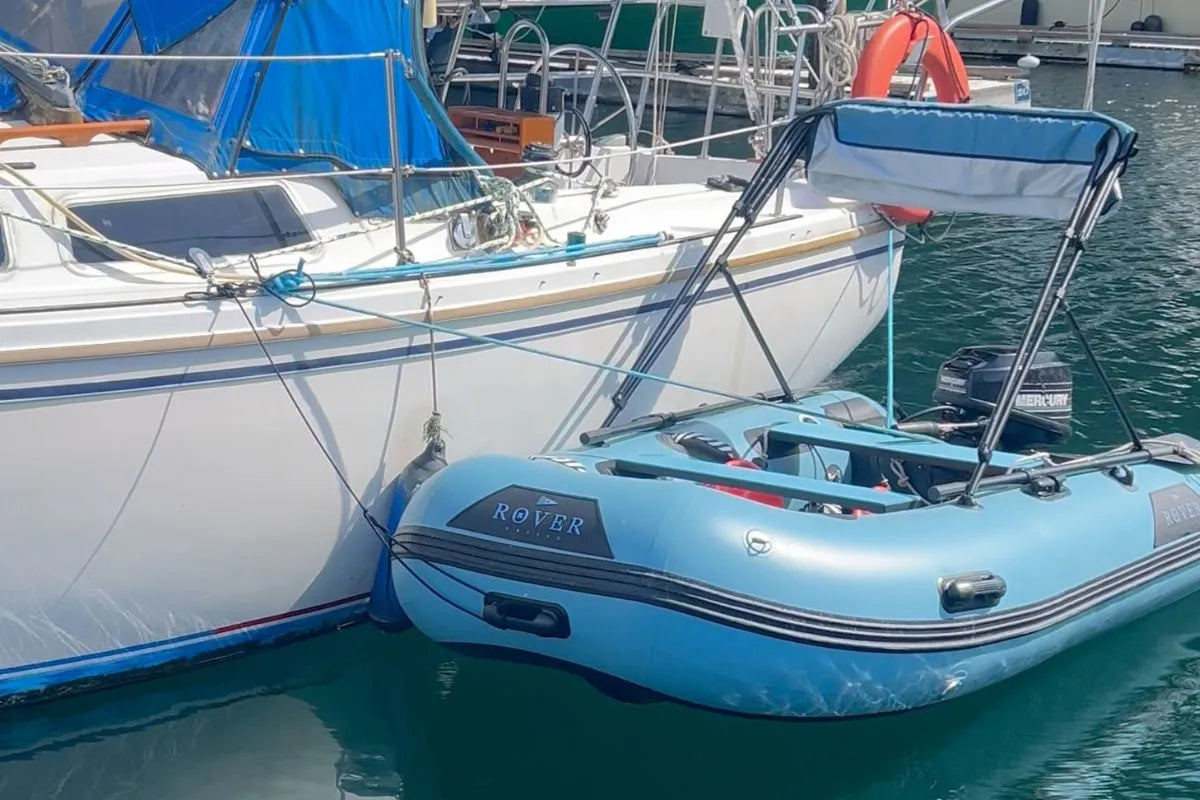
Talk to anybody who has done a real cruising season with a hard tender on the davits and you will hear the same complaints. The dinghy adds weight where sailboats feel it most. It bangs the topsides when wake rolls through the anchorage. It takes up deck, davit, or yard space whether you are using it or not. And the moment you leave a clean tender tied to a public dock in a busy cruising port, you start thinking about cable locks, outboard locks, and whether your painter is tied the way you left it.
This is why we keep getting calls from sailboat owners about the 10' Rover Marine Battle Cat. Not from people who want a pool toy. From cruisers who have already owned a hard dinghy, tried to live with it, and decided there has to be a better way.
Spoiler: there is. It is a 10-foot inflatable catamaran tender built with T3 Woven PVC language on the live product page, V-TEAK style flooring, 4+1 air chambers, 10HP max power, 1,000 lb listed capacity, and the kind of compact-storage logic that actually matters on a sailboat. Military-Grade Tech. Radical Aesthetic. Born in Santa Ana, CA.
Quick answer: The 10' Rover Marine Battle Cat is the sailboat-tender pick if you want catamaran stability, an open-bow layout, a 10' x 5' platform, 1,000 lb listed capacity, 4-person rating, 10HP max power, and a boat that can deflate into a large storage-bag package instead of living permanently on davits. It does not magically weigh nothing. The live page lists 98 lb in the spec panel, 100 lb in another section, and 120 lb for the whole kit with pump and bag. The win is stowage flexibility, soft inflatable contact, and twin-hull stability, not fantasy weight math.

The Three Real Problems With a Rigid Dinghy
Cruisers tolerate a lot. We tolerate marine-grade everything costing more than it should. We tolerate a head that requires a graduate degree to service. We do not have to tolerate the wrong dinghy setup.
1. Davit weight changes how the boat feels
A hard dinghy or rigid inflatable tender can be a great boat, but it still has to live somewhere. If it lives on stern davits, that weight is carried aft every mile you sail. Add an outboard, fuel, lifting gear, painter, cover, and the miscellaneous dock-line mess that somehow collects in every tender, and your sailboat is dragging a lot more than a dinghy brochure admits.
The 10' Rover Marine Battle Cat is not weightless. The live page lists a 98 lb spec-panel weight, another section says 100 lb boat, and the whole kit is listed at 120 lb with pump and bag. The advantage is that it does not have to live on the davits full-time. Deflate it, roll it, and stow it only where your actual storage dimensions allow. Measure the locker, lazarette, berth space, or deck-stowage area before you buy. Not the space you hope you have, the one you actually have.
That changes passage planning. For local harbor hops, it can stay inflated. For a real passage with weather, fetch, following seas, or serious miles, you can deflate and secure it instead of dragging a tender through every sea state behind the boat.

2. Hard hull contact is not friendly to topsides
You know the sound. A hard tender taps your hull once, then wake from a passing trawler turns that tap into a thud. Scuffs along the topsides. Chips around contact points. Fender gymnastics at the dinghy dock. The tender is supposed to make cruising easier, not give your gelcoat trust issues.
The Battle Cat is fundamentally a soft inflatable boat. Its twin inflatable pontoons are more forgiving around a mothership than a hard shell, especially during boarding, short tie-offs, and gentle alongside use. That does not mean you ignore fenders, dock lines, or common sense. PVC can rub, fittings can scratch, and a badly tied tender can still become a problem. But soft-side contact gives you more margin than hard-on-hard contact.
Pretty gear still has to work. Tie it correctly. Fender where contact can happen. Keep it clear of props, ladders, davit gear, and sharp hardware. Then go enjoy the anchorage.
3. Dinghy-dock theft is a real cruising headache
Every cruiser has a dinghy-dock routine. Lock the outboard. Lock the fuel tank if needed. Run a cable through something that is actually structural. Do not leave nice gear sitting loose. Do not assume the friendly harbor is friendly after midnight.
The Battle Cat does not remove theft risk. Nothing does. What it does give you is a more flexible routine. You can deflate and stow it when you are not using it for longer stretches. It is visually distinctive in Battleship Blue. And you are not forced to leave a hard tender exposed on davits or at a dock simply because there is nowhere else to put it.
Lock the outboard separately, always. If your cruising plan includes busy dinghy docks, bring a proper lock system from a marine supplier and use it every time. The one night you skip the lock is the one night the harbor gets interesting.
Stowage Is the Headline Feature
This is the part rigid-dinghy owners have to see to believe. The 10' Rover Marine Battle Cat is a 10-foot by 5-foot, four-passenger, 1,000 lb capacity inflatable catamaran that deflates to a listed 45" x 28" x 18" package. The live spec panel lists 98 lb for the boat, and another section says the full kit is 120 lb with the pump and bag.
That is not a tiny backpack. It is serious gear. But it is also not a 10-foot rigid object that owns your davits forever. For sailboat owners, that difference is the whole story.
Offshore or rough passage
Deflate, dry if practical, pack, and secure the tender below or on deck only where it can be lashed properly. No dinghy flogging from davits in a following sea.
Coastwise cruising
Keep it inflated for short protected moves, or tow only when conditions, speed, and route make sense. Wind matters more than vibes.
At anchor
Leave it inflated for daily ferry duty, swimming, snorkel runs, beach landings, and grocery hauls when the anchorage is protected.
Off-season
Rinse it, dry it, roll it, and store it in a garage, boat locker, or dry storage area. A hard dinghy asks for a rack, yard corner, or trailer space.
The storage win is not that the Battle Cat becomes invisible. It does not. The win is that it becomes movable, packable, and removable from the stern when the sailing matters more than the dinghy.
Inflation Time, and Why the Pump Choice Matters
Skeptics ask: "Sure, but how long does it take to pump up?" Fair question.
The 10' Battle Cat package includes a high-capacity inflator, and the live product page gives two practical timing references: one FAQ says approximately 8 to 10 minutes with the included professional-grade pump, while another section says approximately 10 to 15 minutes to have the boat fully ready. For real cruising use, plan around the safer number: about 10 to 15 minutes when the boat is staged cleanly, the pump is ready, the operator knows the sequence, and nobody is hunting for the valve cap under the cockpit grate.
The inflation sequence matters. The live Battle Cat page tells you to shape the tubes first with a small amount of air, inflate the drop-stitch floor to 7 to 10 PSI, then inflate the tubes to 3.5 PSI and install the oars. Do not freestyle the pressure because somebody in the anchorage says "more air means more better." Set the correct PSI. Instructions matter more than dock talk.
The SHARK 2S Rechargeable Electric SUP Pump is still worth knowing about for SUPs, docks, compatible inflatables, and top-off use where the valve, volume, and pressure requirements fit. The live page lists it at $149, in stock, with an 88.8Wh battery, USB-C and 12V DC charging, 20 PSI max support, 8 universal nozzles, deflation mode, and power-bank mode. It is not presented here as the required primary pump for boat-volume inflation because the Battle Cat package already includes a high-capacity inflator. Use the included inflator and boat guidance first.
For backup, a manual inflation option belongs onboard the same way a manual bilge pump belongs onboard. You hope you never need it. You are glad it is there when the electric option is not.

Why a Catamaran Specifically, Not a Standard Inflatable
Most inflatable tenders are single-hull layouts. The 10' Rover Marine Battle Cat is a twin-hull inflatable catamaran: two pontoons, a reinforced high-pressure floor, an open-bow layout, and a 5-foot beam. For a sailboat tender, that geometry matters.
Stability boarding from a swim ladder
Climbing into a single-hull dinghy from a transom ladder can feel like a balance test, especially with wet feet, a rolling stern, and somebody already sitting on the wrong side of the bench. The dinghy heels toward the boarder, then back the other way.
The Battle Cat's wide twin-hull stance makes boarding feel calmer. The boat still moves because water moves. But the platform is less eager to roll dramatically when weight shifts to one side. That is exactly what you want when kids, dogs, groceries, snorkel bags, and guests are all taking turns getting in and out.
Open-bow water access
The Battle Cat's open-bow design is useful for swimming, snorkeling, diving, freediving, beach landings, and loading from shallow water. On a sailboat tender, that matters more than people think. A tender is not just a taxi. It is the boat that carries groceries, towels, propane, snorkel gear, wet kids, sandy feet, and the person who swears they only need one more trip to shore.
Easy entry and exit is not a luxury. It is the difference between a tender people use and a tender people avoid.
Load behavior at the dinghy dock
The live 10' Battle Cat page lists 4-person capacity and a 1,000 lb load rating. That is enough published capacity for four adult cruisers plus sensible gear, assuming you load the boat intelligently and stay within the rating. The catamaran advantage is not that the printed number magically replaces common sense. The advantage is how a twin-hull boat feels as people move, sit, board, and shift weight.
A single-hull tender may be faster or sharper with one confident operator. A catamaran tender is usually more forgiving when the crew acts like real humans instead of test weights in a brochure.
Construction Credibility Cruisers Care About
Sailboat owners are spec readers. They ask about air chambers, floor pressure, tube pressure, package contents, and what happens after a season of salt, sun, docks, and beaches. Here is what the live 10' Battle Cat page verifies.
| Spec | 10' Rover Marine Battle Cat | Why cruisers care |
|---|---|---|
| Size | 10' x 5' | Big enough for tender duty, still realistic for sailboat storage planning. |
| Capacity | 4 people, 1,000 lb listed capacity | Useful for ship-to-shore runs with people, groceries, dry bags, and gear. |
| Motor rating | Up to 10HP | Enough ceiling for a serious tender motor without overpowering past the rating. |
| Air chambers | 4+1 | More chamber redundancy than a simple single-chamber inflatable setup. |
| Tube pressure | 3.5 PSI | Use the listed pressure, not dock-lot guesswork. |
| Floor pressure | 10 PSI listed in spec panel, with inflation section saying 7 to 10 PSI until firm and rigid | The floor is where the rigid-platform feel comes from. |
| Deflated size | 45" x 28" x 18" | This decides whether it fits your cockpit locker, lazarette, berth storage, or deck plan. |
| Package contents | Boat, two rowing paddles, two reinforced EVA-padded bench seats, high-capacity inflator, repair kit | A tender package should not leave you guessing what is in the box. |
T3 Woven PVC and Thermal Welding Technology
The live product page says the 10' Battle Cat is made with military T3 Woven PVC using Thermal Welding Technology on tube seams. That is the construction language Pop Board Co verifies on the current page. The practical translation for cruisers is simple: this is built as a real inflatable tender for protected coastal waters, bays, harbors, inland waterways, dinghy docks, and beach landings, not a backyard float.
That does not make it indestructible. Oyster shells, fish hooks, sharp dock hardware, dragging over concrete, and lazy storage can still beat up gear. Treat the boat like the tender you depend on, not like a throwaway toy.
V-TEAK style flooring
Rover Marine's V-TEAK flooring is described on the live page as a non-slip PVC deck with hyper-grip texture that improves fit, finish, and footing during boarding and offboarding. In plain English: wet feet need grip. Dogs need grip. Kids climbing in from the water need grip. A pretty deck that turns slick is just a bad idea with better lighting.
4+1 air chambers
The live spec panel lists 4+1 air chambers. That matters because chamber redundancy gives you more margin than a simple single-chamber inflatable. It is not permission to ignore inspection, pressure checks, or repair gear. It is the reason serious inflatable boats use multiple chambers in the first place.
Safety Equipment Before You Add the Motor
A 10-foot inflatable tender with an outboard is still a boat. It needs the same respect as any powered craft: properly fitted, U.S. Coast Guard-approved wearable PFDs for every person onboard, state-required registration or numbering where applicable, a sound signal, required lights for low-light or after-dark operation, and any other equipment required by your state and waterway.
Federal PFD carriage rules require at least one wearable PFD onboard for each person on a recreational vessel, and children under 13 must wear an appropriate Coast Guard-approved PFD while underway unless below deck or in an enclosed cabin, subject to state rules and exceptions. Start with the federal PFD carriage rule, then check your state.
For registration, education, titling, operator-age, and local boating-law questions, use the NASBLA state boating contacts directory. Powered tender rules are local enough that guessing is a bad plan.
Check weather before coastal, harbor, or big-lake runs. NOAA's marine weather warnings guide explains small craft advisories and hazardous wind or sea conditions. Wind matters more than vibes, especially in a 10-foot tender.
Sizing for Your Sailboat
The 10-foot Battle Cat is the sweet spot for many cruising sailboats in the 35-to-45-foot range. It gives you a usable four-person tender platform, 1,000 lb listed capacity, and a 10HP ceiling without stepping into the bigger storage and handling footprint of the 12-foot model.
If your boat is smaller, or you have limited cockpit-locker stowage, look at the 8' Rover Marine Battle Cat. The live page lists it at $1,999, with 8' x 4' sizing, 84 lb boat weight, 2-person capacity, 600 lb listed capacity, and 6HP max power. Same catamaran idea, smaller footprint, easier storage math.
If you are cruising on a larger platform, 45 feet and up, or a serious passage-making catamaran, step up to the 12' Rover Marine Battle Cat. The live page lists it at $2,599, with 12' x 5.5' sizing, 130 lb boat weight, 4-person capacity, 1,200 lb listed capacity, and 20HP max power. Important timing note: the 12' Battle Cat product description currently includes an August 2026 preorder delivery note, so check the live page and cart before making a trip plan around it.
Single-hull-preferring cruisers can run the same comparison on the 10' Rover Marine Battle Boat. Same current $2,249 sale price, same 10' x 5' size, same 10HP ceiling, same 1,000 lb listed capacity, but a traditional single-hull feel that prioritizes speed and maneuverability over the Battle Cat's twin-hull stability.
The Math vs. a New Rigid Dinghy
A new rigid dinghy or RIB can be a great choice if you have the davits, the storage, the budget, and the sailing profile for it. We are not pretending hard tenders are useless. They track cleanly, handle well, and make sense for plenty of boats.
The problem is total ownership reality. A hard tender may bring davit installation, lifting hardware, off-season storage, gelcoat contact management, dock-rash repairs, and a permanent stern-storage decision. Add an outboard, fuel system, locks, and freight or dealer delivery, and the tender decision starts looking bigger than the sticker price.
The 10' Rover Marine Battle Cat is currently listed at $2,249 on Pop Board Co. It gives you a twin-hull inflatable catamaran tender with compact-storage ability, V-TEAK style flooring, 4+1 air chambers, 10HP max power, and a 1,000 lb listed capacity. The value is not just price. It is being able to remove the tender from the stern equation when you need the sailboat to sail clean.
| Decision point | Rigid dinghy or RIB | 10' Rover Marine Battle Cat |
|---|---|---|
| Storage | Requires fixed space, davits, rack, trailer, or yard storage. | Deflates to a listed 45" x 28" x 18" package, with real weight that still needs planning. |
| Hull contact | Hard hull against hard topsides needs careful fendering. | Inflatable pontoons are more forgiving, but still need smart line handling and fenders. |
| Boarding stability | Depends heavily on hull design and weight placement. | Twin-hull stance gives a calmer boarding platform for mixed-experience crews. |
| Passage planning | Often carried on davits or towed unless you have deck storage. | Can be deflated and secured for rougher passages when storage dimensions allow. |
| Look | Classic tender look, often white or grey. | Battleship Blue, V-TEAK style floor, and full Rover Marine attitude. |
Towing It Behind a Sailboat
The Battle Cat can be used as a tender behind a sailboat, but towing any dinghy is a seamanship decision, not a product-photo decision. A towed tender needs a proper tow setup, the right line length, constant monitoring, and conservative judgment. In rough conditions, following seas, long passages, or exposed water, bring it aboard, deflate it, or rethink the plan.
American Sailing's dinghy towing guide is a useful refresher. It recommends a sturdy towline or bridle, adjusting tow position for cruising speed and sea conditions, removing loose gear, never putting passengers in a towed dinghy, and monitoring the dinghy constantly.
For a cruising sailboat, the practical version is simple:
- Tow only in gentle conditions and protected routes.
- Remove loose gear before towing.
- Use a proper towline or bridle setup suited to the tender and load.
- Keep the tender in step with your wake or sea state, not surfing into your stern.
- Shorten the towline before docking, mooring, or anchoring.
- Never tow with passengers in the dinghy.
- Deflate or bring aboard before serious weather, open-water passages, or significant fetch.
Wind matters more than convenience. A tender is only useful if it arrives with you.
Saltwater, UV, and Cruising Maintenance
The Battle Cat is built for real marine use, but saltwater, UV, heat, sand, and lazy storage still win if you give them enough time. The live page describes UV-resistant materials and saltwater-focused construction language, but no inflatable product should be treated like it is maintenance-free.
Daily cruising routine:
- Rinse with fresh water when practical, especially after saltwater use.
- Clear sand and grit from the V-TEAK style floor, valve areas, D-rings, handles, and transom hardware.
- Check tube pressure and floor pressure before longer runs.
- Look for chafe where painters, bridles, docks, and davit gear touch the boat.
- Store out of direct sun when you are not using it for longer stretches.
- Dry before long-term storage to avoid mildew and mystery smells.
You can keep an inflatable tender in the water during cruising stops, and many cruisers do. But continuous immersion brings marine growth, UV exposure, pressure changes, and line-chafe problems. Pull it, rinse it, or at least inspect it regularly. A good tender deserves a basic care routine.
Shop the Post
The full Rover Marine boats and catamarans collection on Pop Board Co currently includes three sizes and two hull styles, with six total SKUs.
10' Rover Marine Battle Cat
$2,249 sale price. The cruiser's pick. 10' x 5' twin-hull inflatable catamaran, 4 people, 1,000 lb listed capacity, up to 10HP, V-TEAK style flooring, T3 Woven PVC with Thermal Welding Technology language, 4+1 air chambers, two bench seats, rowing paddles, high-capacity inflator, and repair kit.
Timing note: live product description currently says August 2026 preorder delivery, while the site banner also says boats are now in stock. Check the live page and cart.
8' Rover Marine Battle Cat
$1,999 sale price. Compact catamaran for boats with tight stowage. Live page lists 8' x 4.5' sizing, 84 lb boat weight, 2-person capacity, 600 lb listed capacity, 6HP max power, 4+1 air chambers, 3.5 PSI tube pressure, and 10 PSI floor pressure.
12' Rover Marine Battle Cat
$2,599 sale price. Step up for larger cruising platforms and longer ferry runs. Live page lists 12' x 5.5' sizing, 130 lb boat weight, 4-person capacity, 1,200 lb listed capacity, 20HP max power, 4+1 air chambers, and 10 PSI floor pressure.
Timing note: live product description currently says August 2026 preorder delivery.
10' Rover Marine Battle Boat
$2,249 sale price. The single-hull sibling. Same 10' x 5' size, same 10HP ceiling, same 4-person rating, same 1,000 lb listed capacity, but with a traditional single-hull feel optimized for speed and maneuverability.
Timing note: live product description currently says August 2026 preorder delivery.
SHARK 2S Rechargeable Electric SUP Pump
$149 sale price. In-stock electric pump with 88.8Wh battery, USB-C and 12V DC charging, 20 PSI max support, 8 universal nozzles, deflation mode, and power-bank mode. Best treated as an SUP, dock, and compatible-inflatable pump option, not the required primary Battle Cat pump.
POP Board Co has been building water gear since 2012. We have always been seen as the taste-makers in our industry, from digitally printed SUP boards to the inflatable dock movement, and the Rover Marine X Pop Board Co lane gives boat owners the same design-first energy in tender form. The Battle Cat is the tender we would want hanging behind our own sailboat, or better, stowed properly when the sailboat needs to sail.
For more context, browse the full Rover Marine collection on Pop Board Co, read the Rover Marine inflatable boat guide, or check the POP Board Co story if you want the EST 2012 backstory.
For delivery planning, check the live product page, preorder notes, cart, and Pop Board Co shipping policy. The shipping policy currently lists 1 to 2 business days for processing, 1 to 10 business days for domestic delivery, free domestic shipping over $100 USD subject to exceptions, and damage reporting within 48 hours of delivery.
FAQ
Is an inflatable boat strong enough as a yacht tender?
Yes, when you buy the right inflatable and use it in the right conditions. The 10' Rover Marine Battle Cat is built for tender duty with T3 Woven PVC and Thermal Welding Technology language on the live page, a reinforced high-pressure floor, 4+1 air chambers, 3.5 PSI tube pressure, 10 PSI floor pressure, and a 1,000 lb listed capacity. It is designed for protected coastal waters, bays, harbors, and inland waterways. It is not a license to ignore weather, overload the boat, drag it over sharp objects, or skip required safety gear.
How fast does the Battle Cat go with a 10HP outboard?
The live 10' Battle Cat page lists power up to 10HP, but it does not publish a verified top-speed number. That means this article does not invent one. With a light load and the right setup, a 10HP outboard gives the Battle Cat useful tender power. Loaded with four passengers and gear, expect the catamaran to prioritize stability and load behavior over chasing top speed. A smaller motor can make sense for slow tendering, harbor rules, and family use. The 10HP rating is the ceiling, not a dare. Follow the boat label, product materials, local laws, and your own operator experience.
Can I leave an inflatable tender in the water?
Short term, yes, many cruisers leave inflatable tenders in the water during active cruising stops. Long term, you need to manage UV, marine growth, pressure changes, chafe, and salt. Rinse when practical, check the painter and tie-off points, inspect the tubes and floor, and pull or deflate the boat before rough weather or longer unattended periods. For storage, rinse with fresh water, dry it properly, deflate it, and store it out of direct sun. Durable does not mean maintenance-free.
Is V-TEAK flooring durable?
The live product page describes Rover Marine's V-TEAK flooring as a non-slip PVC deck with hyper-grip texture designed to improve footing during boarding and offboarding. For a sailboat tender, that is exactly where you want grip: wet feet, sandy soles, dogs, kids, bags, and quick climbs from a swim ladder. Treat it like real marine flooring. Rinse sand and grit, avoid dragging sharp gear across it, and do not store the boat wet and dirty for long periods.
Will the catamaran tow well behind a sailboat?
It can tow behind a sailboat in gentle, appropriate conditions, but towing any dinghy requires seamanship. Use a proper towline or bridle, remove loose gear, keep the dinghy in step with the wake or sea state, monitor it constantly, and never tow with passengers inside. Bring it aboard, deflate it, or secure it differently before exposed passages, heavy weather, following seas, or significant fetch. Convenience is not a weather plan.
Make the Switch
If you have spent a season fighting a hard dinghy, you already understand the question. The 10' Rover Marine Battle Cat solves a different set of tender problems: stowage flexibility, soft inflatable contact, catamaran stability, open-bow access, and a design that does not look like every plain dinghy at the dock.
It is not weightless. It is not magic. It is not a replacement for seamanship, locks, PFDs, weather checks, proper towing practice, or local boating rules. It is a better answer for sailboat owners who want a serious tender that does not have to own the stern forever.
Browse the full Rover Marine inflatable boats and catamarans collection, check the Pop Board Co shipping policy, and read the Rover Marine inflatable boat guide if you want more context before you choose. For more cruiser-grade buyer guides, the POP Board Co blog covers docks, SUPs, pumps, and tenders in the same level of detail.
Made by US, Made for YOU. Thank you for saying YES to POP.


Leave a comment
All comments are moderated before being published.
This site is protected by hCaptcha and the hCaptcha Privacy Policy and Terms of Service apply.